In July I wrote about how we use AI agents at my start-up Daita Labs. Since then, things have sped up a lot.
The number of agentic tasks being handled has roughly quadrupled for me. The Remote Labor Index I cited in my previous essay showed the best model can now autonomously handle 41.25% of remote projects, compared to 15.8% in July.
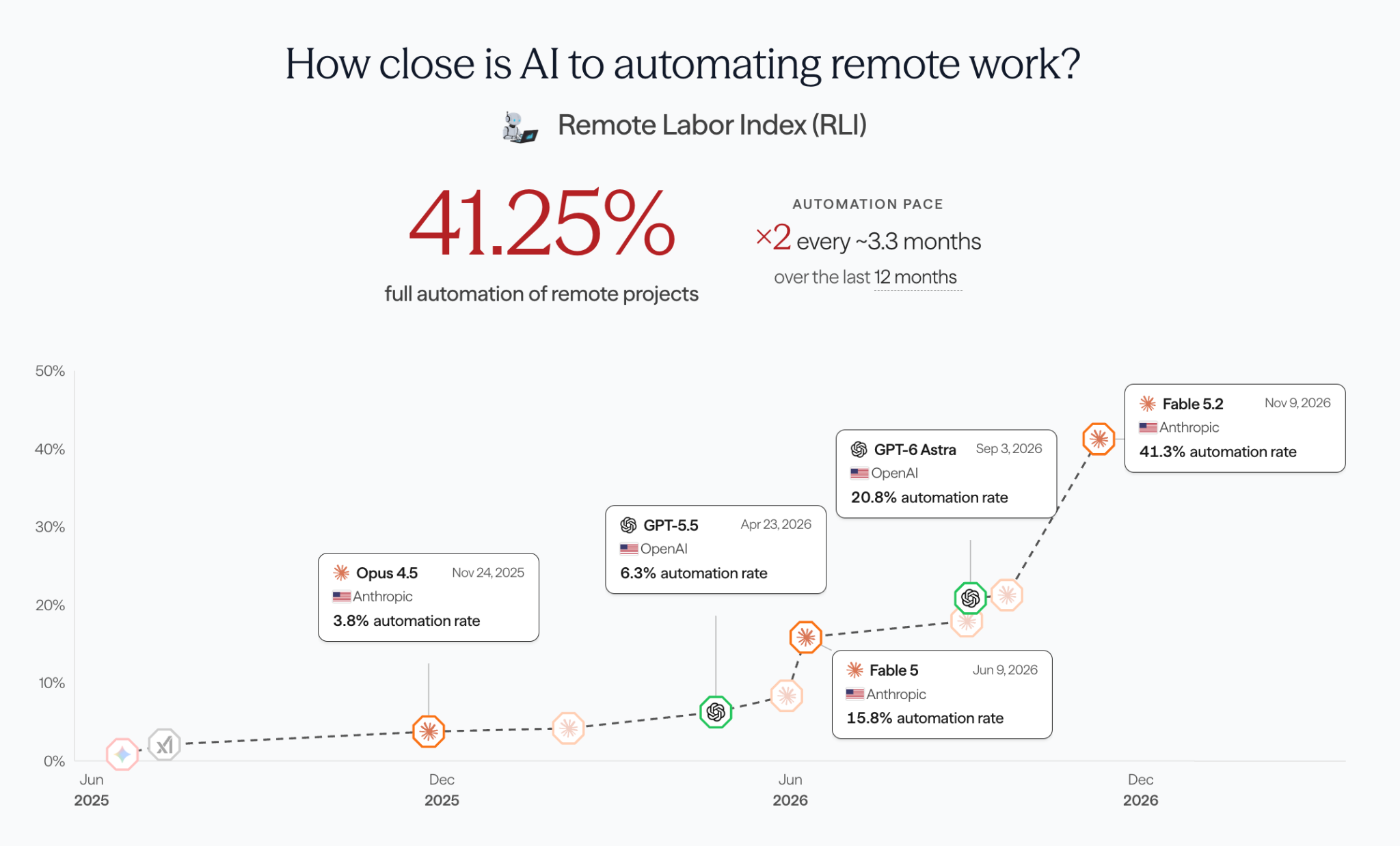
Center for AI Safety & Scale AI, n.d. Link
Beyond just an improvement in LLM models, measured by the index, I think our becoming more accustomed to AI yields a lot of efficiencies. In July I wrote that the main bottleneck is absorption. That’s the case for us and also for our clients.
I constantly encourage my team to share their agentic successes, and builds, and think critically about what tasks to give to AI and what tasks to keep with us. Our instructions to agents and parameters are getting better, our context is too. We’re always learning, sharing and iterating. This is a conscious daily effort we all undertake. I think that is the baseline for any successful implementation of AI (or any new tool really) across the board.
Some varied examples of what we do:
- A workflow has AI checking on changes across our company and updates most of our onboarding documents to be up to date for new joiners.
- Another handles most of our QA work before one of us gets to do QA.
- Some agents share information, others research it, others organise data for us.
- Agents receive our very comprehensive JDs that we prepare ourselves as a team. The agents then set out and start sourcing candidates and organise interviews. We conduct the interview.
- Another’s job is to make sure that calendar meetings and booking pages are always arranged ahead of time for any time-zone-crossing travel.
Does it work straight away? Sometimes, but not always. With most of these we are on the nth version of them. Just as we embrace a complete openness to feedback amongst our team members and with our products, we also share feedback about the performance of our AI help. That feedback gets implemented by AI to result in rapid version upgrades based on real-use events. Needless to say, when employing such agents, data privacy is a key consideration.
What does this leave us with?
One thing I have noticed is with AI handling a lot of execution, such as creatives in Marketing, research in Sales, designs in Product or decks in Customer Support, our role has become more and more to critique, plan and strategise so that the execution is valuable. Where previously you’d have new thoughts and ways arising during the process of making. Now, all of that info has to come before or after the deliverable is done, where execution is handed to AI. That means you need to plan well and judge/critique better to get a valuable outcome. A clear vision and an orderly plan has become even more important than previously.
In my next article, I will focus on how AI is changing the skillset requirements and how I think about judging what to give to AI and what not.
For now, July’s point stands: absorption is the bottleneck. However, four months on, we can add that you can work on it every day and achieve some significant results within a few weeks to months.
This Article’s Artwork: Millet’s The Sower (1850)

Millet first painted the subject in 1847 to 1848. He iterated on it many times with the latest version finishing in about 1865. The subject itself is putting hard work in for a ‘growing’ outcome which makes for a second analogy to the article.
