
We hire teachers for everything. For dance, music, riding, or so Plutarch notes in Moralia. Private schools prove we pay a premium for quality teaching. However, as Plutarch underlines in An virtus doceri possit (Can Virtue Be Taught?), morality and leadership are domains believed to just come about in the person a naturā.
In Moralia, Plutarch deems it ridiculous to say that riding and archery can be taught, whilst “the art of commanding and leading an army comes as it chances”. I’ve had some experience hiring people and building teams. Promoting someone, who is excellent in his craft, to be the leader of his peers does not guarantee success. Leadership in itself is a skill that needs to be taught and learned.
Neither morality nor leadership just come about. There is no great leader that is just born. There is no great good person, other than Christ Himself, that is just born. Both are learned, and both are learned the same way. It is the study of the subject that induces in man such qualities.
Plutarch writes that no character is undefiled by passion. Others go further and argue that much of what passes for virtue is self-interest in better clothes (Glaucon’s ‘The Ring of Gyges’ which Plato debates or Augustine, City of God V.12 to 13).
Goodness is not our starting point. It is what we have to learn.
Christianity aims to create people who are moral towards their friends, their family, their neighbours, and their enemies, or, in other words, people who are good to everyone, or, in yet again other words: moral people.
Now, while salvation is freely given by the act of another, the cultivation, or (re)creation, of the moral person is not something that excludes hard work and study by the believer, but rather the opposite.
Exercise thyself rather unto godliness.
1 Timothy 4:7, KJV. Greek gymnaze: train, as an athlete.
Those things, which ye have both learned, and received, and heard, and seen in me, do.
Philippians 4:9, KJV
Those who by reason of use have their senses exercised to discern both good and evil.
Hebrews 5:14, KJV.
Christians are made, not born (Tertullian, Apology 18.4).
Christianity’s approach includes a disciplined reading of Scripture, which is in large part literature on morality, history and philosophy, expanding one’s understanding on morality. It includes daily introspection (prayer), against one’s understanding of what good is. Introspection is followed by seeking forgiveness for where the mark was missed and asking for help to do better. This is the very process of learning: Study, examination and application. The process by which one becomes more moral is learning. It is not being born with it. It is not somehow morphing into it unguided.
Leadership behaves much like it. Whether the great saints, emperors or philosophers, none are known to have just appeared as they are remembered. Rather, their coming about is a product of dedication to study and practice.
As for the leadership qualities that brought us the heads of the greatest empires in world history, Alexander studied Homer under Aristotle, Caesar studied Alexander, Napoleon studied both.
Napoleon’s Military Maxims, compiled in 1827, advise (LXXVIII, d’Aguilar tr. 1831): “Peruse again and again the campaigns of Alexander, Hannibal, Caesar, Gustavus Adolphus, Turenne, Eugene and Frederick. Model yourself upon them. This is the only means of becoming a great captain”.
Napoleon dictated his own study of Caesar: Précis des guerres de César, at St Helena whilst in exile.

Bonaparte studying at Brienne. Illustration by Job, from Georges Montorgueil, Bonaparte (Boivin, 1908).
Philip II, in his capacity as King of Macedonia promised Aristotle that he would pay him by rebuilding Aristotle’s hometown if he came to teach his son in ethics and politics. Aristotle did, the city was rebuilt and Alexander the Great was educated.
Alexander said he would rather excel in knowledge than in power. After Aristotle made his advanced lectures public, Alexander wrote to him asking in what he would surpass other men if those doctrines were common property.
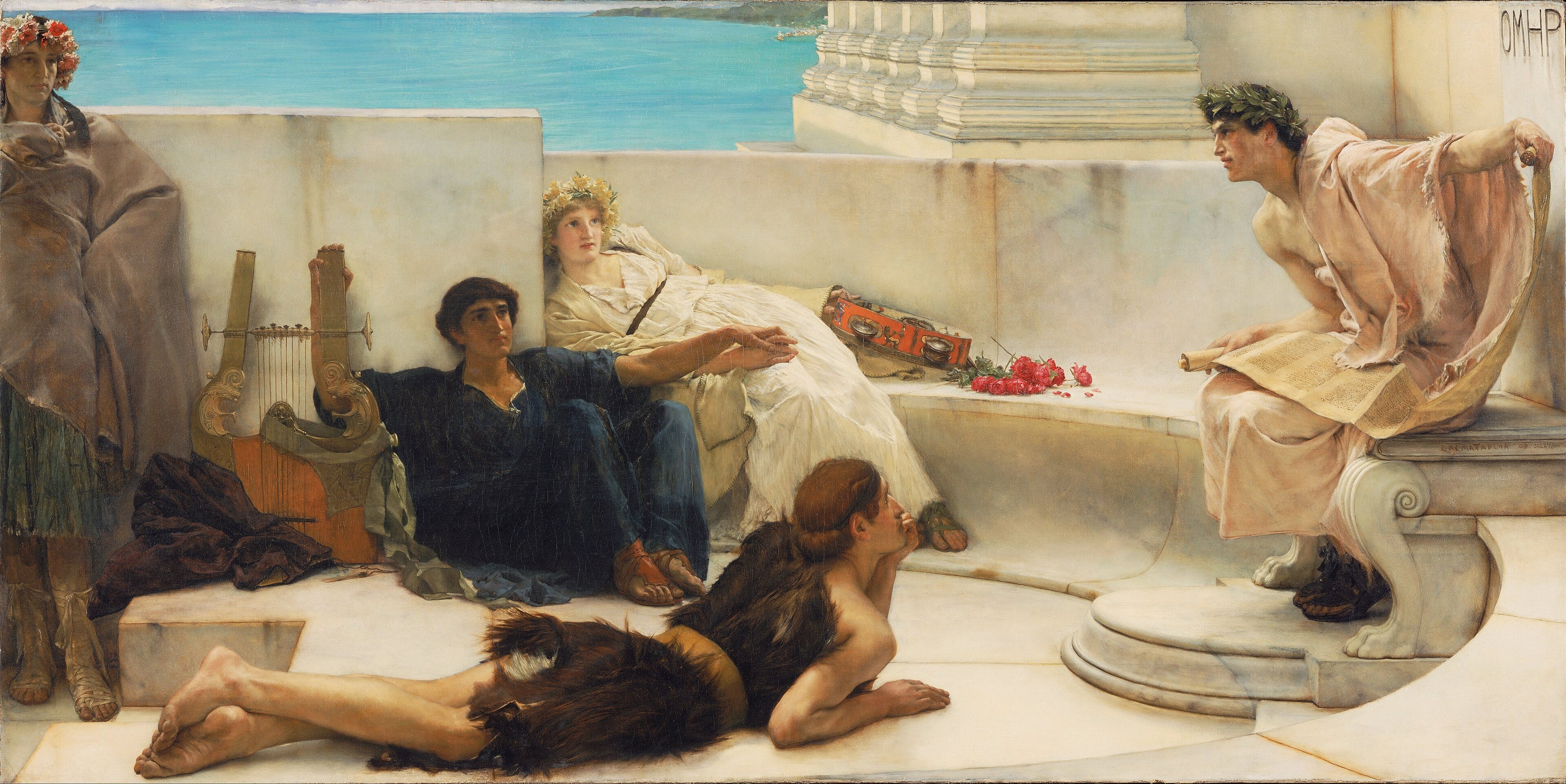
Sir Lawrence Alma-Tadema, A Reading from Homer, 1885, oil on canvas, Philadelphia Museum of Art (George W. Elkins Collection, 1924).
Caesar sailed to Rhodes to study under Cicero’s teacher Apollonius Molon. Cicero later said Caesar could have been Rome’s first orator.
Plato sailed to Sicily twice to teach Dionysius II (his first visit had been to the father’s court), who was the ruler of Syracuse, at the time Greece’s most powerful city. Plato described Dionysius II as having the natural gift of a capacity for learning and an extraordinary love of glory. However, the ruler wanted a philosopher’s reputation without the work. He did not attend lessons, claiming he knew the teachings already. He was deposed within four years and ended his life in Corinth as a schoolmaster. He had a gift, but rejected education and the gift amounted to nothing.
Aristotle in Politics III.4 writes: “He who has never learned to obey cannot be a good commander.”
Machiavelli in The Prince advises the prince to read history and imitate great men.
Deuteronomy 17:18-19 says that the king of Israel must write a copy of the law and read it all the days of his life.
In 1 Kings 3:9, Solomon asks for an understanding heart to judge his subjects.
Augustine, after having been ordained as a priest through public demand, wrote a letter to Bishop Valerius asking for time to study before performing the office (Letter 21, 391 AD). Saint Augustine got the time, and continued to study, producing some of the West’s most influential works.
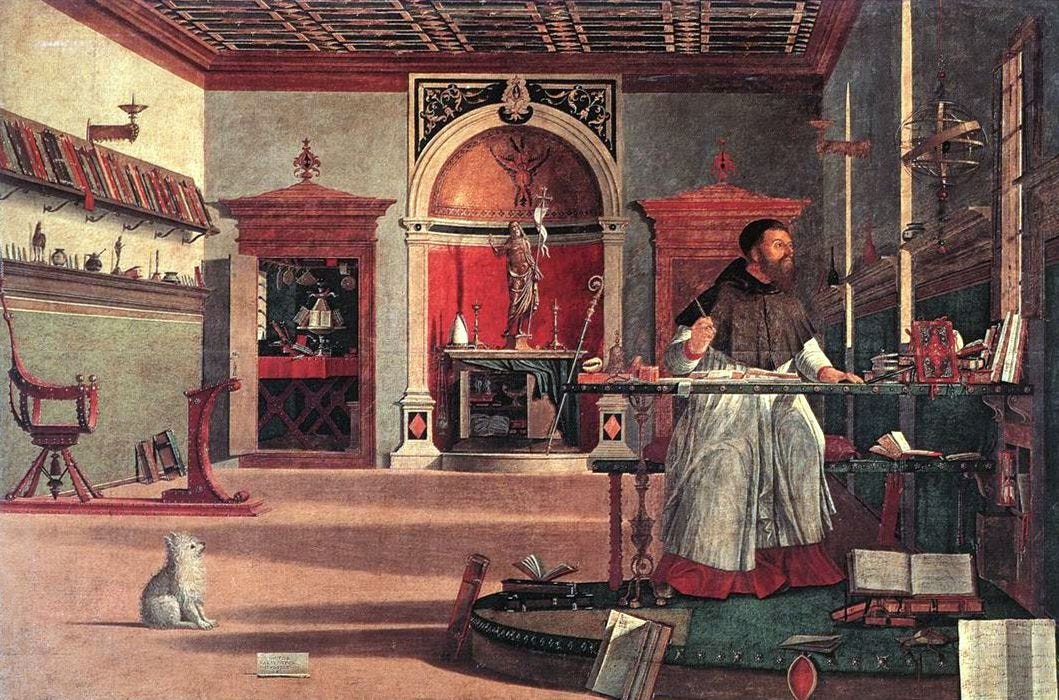
Augustine is writing to Jerome, when he learns Jerome has died. Vittore Carpaccio, The Vision of Saint Augustine (also called Saint Augustine in His Study), 1502, tempera on canvas. Scuola di San Giorgio degli Schiavoni, Venice.
Leadership is the “art of arts and science of sciences,” said Gregory of Nazianzus, who was ordained by his father and wrote that no one should attempt leadership without preparation.
Pope Gregory the Great later borrowed the phrase from his namesake and in his Pastoral Rule I.1 writes: “No one presumes to teach an art till he has first, with intent meditation, learnt it. What rashness is it, then, for the unskilful to assume pastoral authority, since the government of souls is the art of arts?”
We can conclude then, to be moral, and to be a good leader, one must study. However, it must be noted, as the biblical quotes above clearly showed, that the knowledge must not be just learned, but exercised.
Plutarch, Can Virtue Be Taught? 439C to D
(Patrick tr., Goodwin ed. 1874)“And will ye say, O foolish men! that the skill of ordering one’s life well (for the sake of which are all the rest) is not to be taught, but to come of its own accord, without reason and without art?
Why do we, by asserting that virtue is not to be taught, make it a thing that does not at all exist? For if by its being learned it is produced, he that hinders its being learned destroys it.”
Proverbs 4:13, KJV
“Take fast hold of instruction; let her not go: keep her; for she is thy life.”
