I’ve written many times about the importance of building the context layer for an AI, call it ontology layer or semantic layer, what I mean is a structured, machine-readable definition of what the things in a business actually are, maintained so that AI models have something solid to work against.
Chinese JD.com has now published a detailed account of what that looks like when it is done at the largest of scales.
JD is one of the world’s largest e-commerce platforms, with 700 million users, millions of merchants and a catalogue containing tens of billions of SKUs. The software it built to keep track of all this is called the Oxygen AI Item Center. It covers tens of thousands of categories and processes hundreds of millions of item updates per day, running on Huawei Ascend NPUs, in line with China’s broader push towards technology sovereignty. JD describes the system in a technical paper on arXiv; Jack Clark flagged it in Import AI.
Four elements make it work:
The first is ontology engineering, run as a collaboration between people and models. Human experts concentrate on distilling what they know about each industry and category, and the algorithms learn from that input to build out the ontology at scale and keep it evolving as new products and concepts appear. The result is a live map of everything JD sells, with millions of entries, rather than a static taxonomy that goes stale the month after it is finished.
The second is an architecture JD calls Semantic Search then Discrimination. The ontology is externalised into a separate knowledge base, which means it can be updated continuously without retraining any models. When a new or changed item arrives, the system first searches that knowledge base for the ontology entries the item might belong to, and the model then only has to decide whether the item matches the retrieved entries. Splitting up one task into several and then framing those tasks this narrowly reduces their complexity, thus it cuts down hallucination.
The third is a set of item-understanding language and vision models designed to improve over time. Rather than retraining one monolithic model whenever requirements change, the team builds lightweight expert modules and integrates them into an expert pool as needed, making it easily adaptable over time. This incremental approach fills targeted knowledge gaps, and it lets capability expand quickly when a new category or task appears. Since each task of matching had been broken down cleanly, they’d also find it easy to spot where amongst product groups the weaknesses of AI recognition are.
The fourth is what JD calls the unified item tunnel, the main interface between Oxygen AIIC and the rest of the business. It serves item knowledge to downstream applications through pipelines that run at daily, minute and second cadence, while keeping the data consistent across all of them.
Taken together, this is a business function that lends itself to rapid improvement. Intelligence sits inside the inventory system rather than around it, which is what lets JD operate at a scale no earlier back office could support, with comparatively little human oversight once the structure is in place.
Notice what the four elements have in common: none of them is a bigger or cleverer model. All four are ways of defining, organising and serving knowledge so that models of ordinary ability can do reliable work against it. That is what building a good ontology layer and a semantic layer means in practice. The models will keep improving and being swapped out. The definition of their relevant own world is where start-ups should focus and create massive value.
Understand > break down > define > analyse each module > upgrade each module
This Article’s Artwork: Antonello da Messina’s St Jerome in His Study (1475)
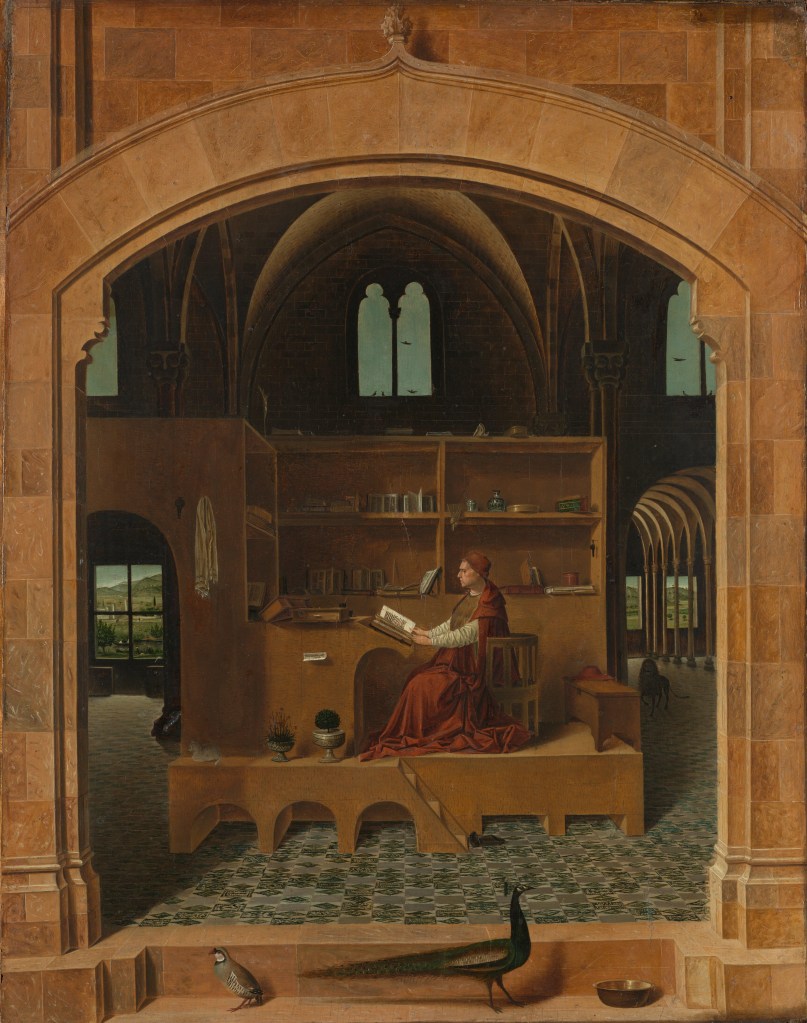
This article’s artwork shows Saint Jerome, my namesake, in his study. Jerome spent more than two decades rendering scripture from Hebrew and Greek into Latin, and the result became the Vulgate, the standard text beneath Western Christendom for a thousand years: liturgy, theology, law and art all compiled against one settled layer, one point of reference.
Antonello paints a portrait of a man quietly building the layer Western civilisation would be built and run on.
