
In the factories we work with, floor in-charges never open our platform. The system reaches them on WhatsApp, inside the flow they already work in, while merchandisers use the full product. Nothing about that decision involved a model. It is workflow, context, permissions: the unglamorous layer around the AI, and the layer where a large share of our engineering time goes.
Lilian Weng has now given that layer a definition and an argument. In 2023, at OpenAI, she wrote the essay that taught a generation of engineers to think of LLM agents as planning, memory and tool use. Her new piece, written as a co-founder of Thinking Machines Lab, widens the frame. The interesting object is no longer the agent alone but the harness around it. The layer between the model and the real world, she argues, “seems to be as important as the model’s raw intelligence”.
A harness is everything that surrounds the model and decides how it actually behaves: the workflows it operates inside, the context it is shown, the permissions that govern what it may touch, the evaluation that checks its work, the state that survives between sessions. She compares it to an operating system: complicated machinery behind a simple interface. The model supplies intelligence. The harness turns intelligence into reliable work.
In her world, the harness can increasingly build itself. Coding agents live in digital environments where every failure leaves a trace a machine can read: the repository, the test suite, the logs. So the harness studies its own mistakes and proposes its own improvements. She is precise about where that world ends. The loop needs evaluators that are fast, objective and precise, and the first open challenge on her list is that many real tasks lack them. A garment factory is that challenge made physical. The material the harness must be built from is written down nowhere. It sits in how a merchandiser actually spends his morning, in what a floor in-charge will and will not type into a phone, in the gap between what a meeting agrees and what the floor does the next day. A harness like that cannot be searched into existence. It has to be understood first, and understanding it is slow, human work.
That is the work DAITA has been doing. The harness we built had to encode who acts when an order starts slipping, which of the week’s delays actually matter, who may tell whom that a delivery will be late.
Two years before her essay appeared, I moved to Tiruppur, India, on the assumption she has now written the essay about: that whether the technology worked would be decided as much by everything around the model as by the model itself. More than one hundred factory visits later, that layer is the substance of what we have built. The models improve everywhere at once, for everyone, on the same day. Much of the generic harness may follow; she suggests the models could eventually absorb a good part of it. But she is clear about what should remain: the interface with external context, the model’s connection to the world it works in. That is the layer we build. And ours could only be learned factory by factory.
This Article’s Artwork: Pieter Bruegel the Elder’s Parable of the Sower (1557)
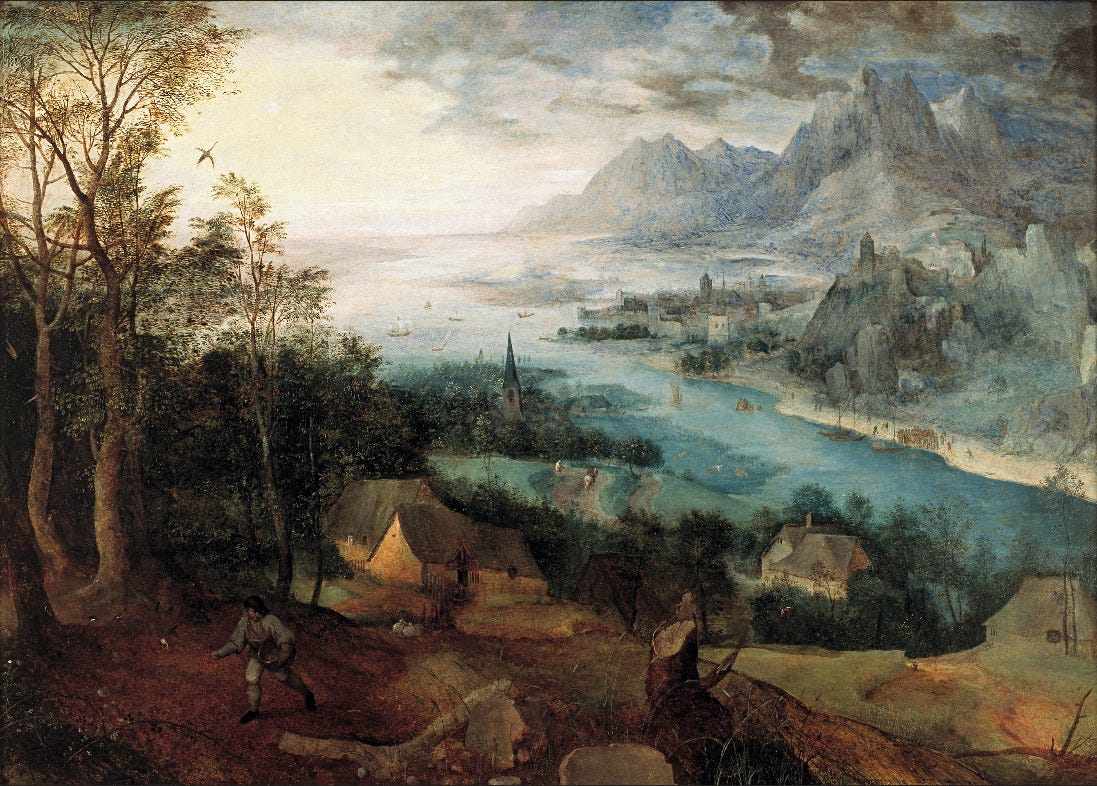
This article’s artwork depicts a famous biblical parable recorded in Luke, Matthew and Mark. Luke 8:4-8 reads the following:
4 While a large crowd was gathering and people were coming to Jesus from town after town, he told this parable: 5 “A farmer went out to sow his seed. As he was scattering the seed, some fell along the path; it was trampled on, and the birds ate it up. 6 Some fell on rocky ground, and when it came up, the plants withered because they had no moisture. 7 Other seed fell among thorns, which grew up with it and choked the plants. 8 Still other seed fell on good soil. It came up and yielded a crop, a hundred times more than was sown.”
My article is about raw intelligence needing the right environment, the right harness, or the right way of being received. In Jesus’ parable, He says that He shares the Word of God, that gives Life, but that many who will hear It will not be able to receive It for various reasons He outlines. He says, it is just the fourth soil that will bear good and plentiful fruit. My article reminds me of this passage and I think the principle of something valuable being shared but not well-received transcends this business use case and is far larger and more common.
