When feedback comes in from one of our clients, an agent reads it and turns it into a Linear ticket for the engineering team, correctly prepared and correctly sized, then asks for human approval. Another agent runs our recruiting. Another collects updates and then writes our newsletter (not this newsletter!).
The Remote Labor Index, built by the Center for AI Safety and Scale Labs, measures whether AI agents can complete real freelance projects at a quality a paying client would accept: remodelling an engagement ring in CAD, animating a one-minute advert, producing dimensioned floor plans from a scanned site plan. Human evaluators judge every deliverable against the work of a paid professional. At launch in October 2025, the best agent completed 2.5% of projects. This month:
- GPT-5.5 at 6.3%,
- Claude Opus 4.8 at 8.3%,
- Claude Fable 5 at 15.8%.
The researchers note the frontier has “more than quadrupled in under eight months”, and that most deliverables still fall short of professional quality. The level is low. The speed is not. The family at the top of that list is the one our agents run on.
I watch this from both sides. I deploy AI into garment factories, and I wrote in April about how that goes: people who agree with total enthusiasm and never start, onboarding that only sticks through named owners and daily repetition. In my experience, the capability of the technology is far less of a constraint than the organisation it lands in.
Inside my start-up Daita Labs, the same technology meets no resistance. There are ten of us. Nobody’s routine depends on the old way, because there is no old way. We create tools to work alongside us. Our recruiting agent never had to win over a team. The ticket agent never threatened anyone’s role, because the role never existed.
People will augment themselves and new work will appear; the question is whether that happens as fast as the machines improve. My bet is that the impact of these new AI tools arrives less through existing firms adopting agents and more through new companies that never created the roles in the first place. Adoption is slow wherever people have an established way of working. Adoption is fast where a company must rely on the technology to grow or survive, as adoption increases through the industries, more will fall in the latter camp.
Capability sets the ceiling. Absorption sets the speed.
The bottleneck is not AI maturity anymore, it grows better, faster, than most can adopt it today.
This Article’s Artwork: Waterhouse’s Penelope and the Suitors (1912)
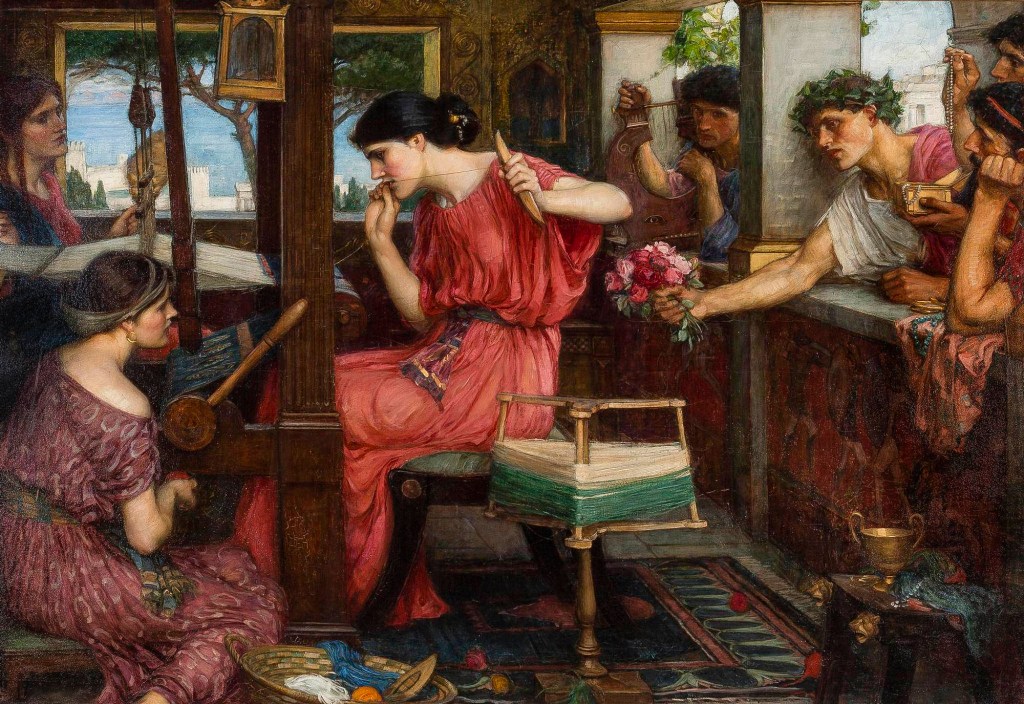
In this article’s artwork, set in Homer’s world, Odysseus has been gone twenty years, ten fighting at Troy and ten lost on the journey home, and the island of Ithaca has given him up for dead. In his absence more than a hundred suitors have installed themselves in his house, pressing his wife Penelope to remarry. To hold them off she promises to choose the moment she finishes weaving a burial shroud for Odysseus’s father, then unpicks each night what she wove that day, so the cloth is never done. Waterhouse catches her at the loom with the suitors leaning in at the edges, in the middle of a delay she keeps up for three years. Penelope’s primary motivation is her enduring love for Odysseus and her hope for his return. Despite 20 years of absence, she holds onto the belief that he is alive. In Greek epic poetry, their marriage is defined by homophrosyne, a rare, deep unity of mind and spirit. To her, marrying any of the suitors would mean violating that sacred bond.
