
Mercedes
In 1998, Daimler-Benz (nowadays: Daimler AG) was one of the biggest German car manufacturers, most famous for its subsidiary Mercedes-Benz as well as a range of commercial vehicles (Walton, 2021). Daimler-Benz was a German company that would be described as conservative, safe, and efficient by their customers. This image is upheld by the company until today. In terms of working culture, they had a clear hierarchical structure with a clear command chain and respect for authority. In terms of their products, Daimler-Benz valued reliability and achieving the highest possible level of quality for their vehicles. (Commisceo Global, n.d.)
Chrysler
In 1998, Chrysler Corporation was one of Americas biggest carmakers, most famous for their Chrysler cars. It merged with Fiat and afterwards with PSA Group to create Stellantis, to which the Chrysler brand now belongs (Burn, 2021). Chrysler was known as creative, diverse, and daring by their customers. Instead of a clear hierarchy with clear command chains, Chrysler favoured a more egalitarian team-based approach within their work culture. With their products, they focused on catchy designs and competitive prices to sell their vehicles. (Commisceo Global, n.d.)
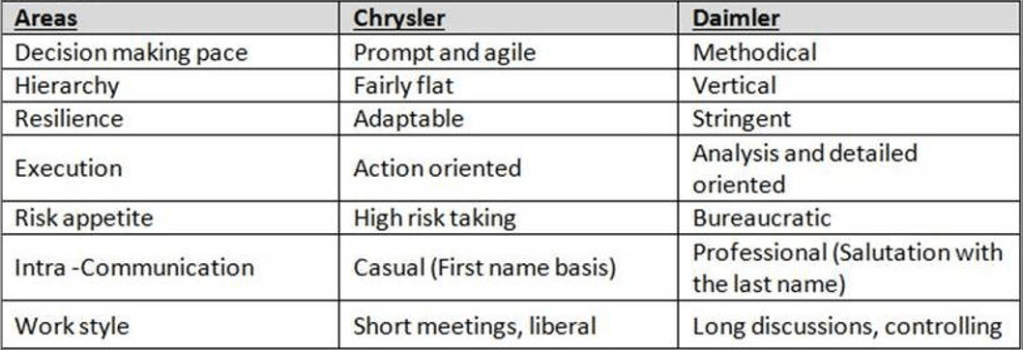
In 1998, Daimler-Benz and Chrysler Corporation chose to merge as a response to the economically challenging environment for carmakers at that time (Beuron et al., 2010). However, the merger failed due to a cultural mismatch. As can be seen with the previous two paragraphs the companies have clear cultural differences, which resonate with that of their origin countries. The same issue was also prevalent in the management. German and American managers had different approaches to managing the merged company, as their company images differentiated a lot, leading its sections into different directions. Another issue, apart from work culture, was trust. The merger was announced as “merger of the equals” (Commisceo Global, n.d.), however, the initial stages saw a lot of Chrysler Corporation executives either resigning or replaced by Germans, as well as Chrysler Corporation executives receiving much higher salaries. This issue was a hint to the future in which Daimler continued to be more imposing and dictating on stirring the merged company. This is likely due to Daimler being a hierarchical based command-chain company that saw the more egalitarian approach of Chrysler as a weakness to balance out and an empty chaotic space to put their structured command mechanism into. The array of operating issues produced by the cultural mismatch is summarised in Figure 1.
Differences in Operating Style at Chrysler and Daimler
Management of the Cultural Gap
The merged company took multiple measures to try and close the chasm between the two company cultures. There are press reports that indicate that the former Daimler-Benz management was trying to dress more casually to fir American apparel (Rahman, n.d.). The former Daimler-Benz employees were educated about cultural awareness and the former Chrysler Corporation employees were taking German classes to match the English skills of their German counterparts. While the Americans were encouraged to make more specific plans, the Germans were encouraged to experiment more freely. To celebrate the IPO of the merger, German employees celebrated with American food, music, and cheerleaders (Rahman, n.d.). It must be mentioned that just because all these measures were in place, it does not mean that the employees on either side adapted accordingly. An eyewitness account published on Forbes mentions that a German host of a meeting was asked to conduct it in English for the benefit of an American Colleague. His reply was “NO!” (Garsten, 2019)
However, while these measures were aimed at bringing the two cultures closer together, Daimler-Benz continued to impose their management style upon the Chrysler Corporation management, this could be felt throughout the entire merged business and discouraged employees and made the Chrysler Branche much less functional, leading to a significant loss, followed by elimination of American branches to get the Chrysler Corporation section back into profitability (Rahman, n.d.).
The same issue occurred in the Daimler Mitsubishi merger where Daimler imposed their German direct and fact-based, pragmatic management-style upon the higher-context Japanese Mitsubishi company culture (Commisceo Global, n.d.). As a result, the Japanese felt reluctant to take German orders as they value business relationships and put emphasis on how one treats them in business (Commisceo Global, n.d.). In the end, both mergers failed due to the cultural mismatch. It must also be mentioned that in both cases Daimler-Benz is the acquiring party, which comes along with more authority intrinsically. Daimler-Benz ended up selling 80.1% of Chrysler to a private equity firm in 2006 and did not attempt to merge with them again (History.com Editors, 2009). Chrysler merged with Italian Fiat, in what according to an eye-witness account published in Forbes, had been a much more successful and considered merger that supposedly learned from Daimler-Benz’s mistakes (Garsten, 2019).
The Situation in Light of Cultural Theories
The failure of the merger was due to the cultural mismatch of German Daimler-Benz, and American Chrysler Corporation. As hinted at in the introduction, the cultures of the businesses are reflecting that of their origin countries. This makes sense as both businesses were set up by founders originating from their respective countries. Germany is a Long-term oriented country, reaching a score of 83 on the Hofstede Long-term Orientation Scala, whereas the US is the opposite at 26 (Hofstede Insights, 2021). This means that German culture is far more pragmatic, thus, Germans believe the truth and the plan that should be pursued depends on the circumstances (analysis). Their high long-term orientation does also account for performance being measured upon future estimates more so than short-term successes and failures. This can be found in the culture of Daimler-Benz, as the company bets on good long-lasting quality and designs. On the other side, American’s have a strong predetermined set of ideas about good and bad. Their short-term orientation also means that they measure performance on a short-term basis, mainly through profit and loss statements quarterly, leading to a focus on quick results. This can also be deducted from Chrysler Corporation’s products which rely on competitive short-term changing prices and designs. This leads the different sections of the merged corporation to pursue different outcomes which in turn lead to dissatisfaction from the other side.
Another point of cultural mismatch was found in their approach to the management hierarchy. While both origin cultures have a similar power difference, there is a significant difference in individualism. Germany scores mid/high 63 points while the United States score significantly higher at 91 (Hofstede Insights, 2021). The higher individualism, the higher the cultures focus on equal rights for every individual, regardless of their makeup. In business this translates into hierarchies being established accessible, as well as managers relying on – and consulting – certain individuals and “regular” employees just like managers, depending on the problem. In less individualistic Germany however, managers are expected to know most things themselves and give their employees clear instructions. This factor combined with Germanies 19 points higher uncertainty avoidance (Hofstede Insights, 2021), leads to a different management culture. The difference in uncertainty avoidance is clearly noticeable too as Daimler-Benz valued being prepared, with thought-through details before pursuing a plan, whereas Chrysler Corporation was more daring to figure out some details along the way. The same concept can be found with their products. Daimler-Benz management was betting on conservative known-to-be good designs and materials, while Chrysler Corporation dared to try new “trendy” designs for their cars. From Daimler-Benz’s side, the management of the newly merged corporation was expected to give clear instructions and commands to their subordinates and the management itself expected respect and obeying from the employees. From Chrysler Corporation’s viewpoint, however, interactive managing across different hierarchical levels as well as more tolerance for testing and trying out things were the custom.
Suggestions
Both companies have a culture that is very similar to that of their origin country. This makes sense as the people who founded – and most of those who work for – each company come from their respective countries. The issues mentioned throughout the essay, could be clearly connected to those different cultural traits.
My suggestion to improve a merger like this would be to prepare the employees of both sides for the merger before it happens. Both companies stuck to their cultural identity, however, when two companies merge, their culture should become one. In an ideal scenario that would be a culture where the strength of both origins combine and cancel out the weaknesses of each, perhaps starting with joint research projects. To facilitate that, the companies should restructure all processes. Instead of having all of them done 50/50, Americans should have been focused alongside their strengths on things such as innovativity and product design. While the Germans should have been positioned alongside analytical and bureaucratical tasks such as market analysis and so on. This could lead to German analytical results determining which of the creative American solutions should be pursued in the future. This is only one example of how to position the culturally different workforce efficiently along with the tasks of the merged business. Alongside it, equality in terms of payment must be established. This merger saw American subordinates reporting to lower-paid German executives which created further tension. Since pay-cuts would lead to discouragement for one sight, the other one should be levitated onto the same level. In terms of leadership, there should have been a skill assessment beforehand to prevent Americans from being replaced on short notice by Germans. This would have led to less rejection and decline within the Chrysler Corporation section. This issue persists throughout all this merger’s history. Two successive presidents at Chrysler were fired and replaced by a German one. There was no Chrysler presence in the board of management. This led to the Chrysler branch underperforming and thus less funds and less focus was given to it. Consequently, this made the Chrysler division worse and worse while the Daimler one grew stronger due to the focus it received, leading to further personnel cuts for the Chrysler branch and a greater unbalance (THINQ ON PURPOSE, 2016). To achieve the suggestions made, there needs to be plenty of time to assess if it is possible and how it is possible. This merger took place within 12 months, a timeframe that could have been expanded to include thorough due diligence and analysis to make suggestions such as this essay has done. Daimler-Benz could have also purchased Chrysler Corporation in instalments, instead of all at once. This would have allowed both companies to split ways easier once they realized that their merger did not work as hoped for.
However, the issue is that both corporations must surrender their way of doing things as well as their product to the merger, which will result in a different product, a different brand image and finally a new merged culture. In Daimler-Benz’s and Chrysler Corporation’s case, both companies wanted to maintain their way of doing things, their image, and their culture, while still wishing for the economic benefits of joining forces. However, due to the lack of cultural awareness, acceptance, and adoption, the merger failed.
References and suggested reading
Burn, J. (2021, January 16). Stellantis: FCA and Groupe PSA merger confirmed . Retrieved from Auto Express: https://www.autoexpress.co.uk/fiat/108280/stellantis-fca-and-groupe-psa-merger-confirmed
Commisceo Global. (n.d.). Cultural Differences in International Merger and Acquisitions. Retrieved from Commisceo Global: https://www.commisceo-global.com/blog/cultural-differences-in-international-merger-and-acquisitions#:~:text=Cultural%20factors,-Analysts%20agree%20that&text=Daimler%20was%20a%20very%20hierarchical,in%20terms%20of%20their%20clients.
Garsten, E. (2019, June 02). First Person Account- Living Through DaimlerChrysler, Chrysler, Fiat Chrysler Culture Changes. Retrieved from Forbes: https://www.forbes.com/sites/edgarsten/2019/06/02/first-person-account-living-through-daimlerchrysler-chrysler-fiat-chrysler-culture-changes/?sh=cdd41ce36a74
History.com Editors. (2009, November 13). Daimler-Benz announces purchase of Chrysler Corp. Retrieved from HISTORY: https://www.history.com/this-day-in-history/daimler-benz-announces-purchase-of-chrysler-corp
Hofstede Insights. (2021). COUNTRY COMPARISON. Retrieved from Hofstede Insights: https://www.hofstede-insights.com/country-comparison/germany,the-usa/
Julia Hollmann, A. d. (2010, December). The DaimlerChrysler merger – a cultural mismatch? The DaimlerChrysler merger – a cultural mismatch? Revista de Administração da UFSM, 3(3), 431-440. Retrieved from https://doaj.org/article/3e63c1ef5015407a9a4241b12fc2afe1
Rahman, N. (n.d.). Case 1: Daimler–Chrysler Merger: a Cultural Mismatch. Retrieved from Academia: https://www.academia.edu/7116149/Case_1_Daimler_Chrysler_Merger_a_Cultural_Mismatch
THINQ ON PURPOSE. (2016, Ocotber 16). Daimler-Chrysler (DCX) Merger: A Cultural Mismatch . Retrieved from THINQ ON PURPOSE: https://medium.com/@beotra.nehaa/daimler-chrysler-dcx-merger-a-cultural-mismatch-2cbb3a05321d
Walton, J. (2021, June 24). Top 6 Companies Owned by Daimler AG (DDAIF). Retrieved from Investopedia: https://www.investopedia.com/articles/company-insights/092716/top-6-companies-owned-daimler-ag-ddaif.asp
