
The healthcare industry has been the subject of rapid and transformative innovation since its inception. In recent decades, the creation and analysis of data has become a key part of diagnosis, R&D, treatment and many more sectors of the industry. Precisely this trend of ever-increasing quantities and complexity of data positions the industry in an ideal place to leverage AI. This research assignment will investigate the history of innovation in healthcare; How the healthcare industry is currently exploiting AI and can further implement and utilise it, and finally, what some potential barriers could be. This research assignment does not intend to be exhaustive and cover all the aspects of AI and healthcare within its comprehensive word count. Instead, it aims to create a clear narrative showcasing some examples of how the healthcare industry is utilising, exploiting, and implementing AI today to give the reader an idea of how the healthcare industry is and will be shaped by AI.
A Historical Perspective of the Healthcare Industry
Few industries have been so substantially shaped by – and known for- innovation as healthcare. The history of healthcare is a narrative of constant innovation and adaptation, for the sake of profitably improving patient outcomes and operational efficiency. From the inception of modern medicine, the invention of antibiotics (1920s – 40s), vaccines (20th century), medical imaging (20th century), organ transplantation (1950s), genetic engineering and biotechnology (1970s), stem cell therapy (Late 20th Century), minimally invasive surgery (1980s), each era witnessed transformative advancements. The last two decades have seen the introduction and impact of telemedicine, precision medicine, and finally, artificial intelligence.
The latest inventions appear at a time when development & innovation in the healthcare industry are much needed due to an ageing population, a shift in lifestyle, changing patient expectations (Spatharou et al., 2020), combined with labour shortages and pay disputes amongst healthcare workers across developed economies (Waitzman, 2022 & Magunia et al., 2022).
Exploiting, Implementing and Utilising AI in the Core Business
The core business activities of the healthcare sector are providing treatment to patients, manufacturing medication, payers, pharma services & healthcare technology.

Note. This figure was taken from McKinsey & Company (Patel & Singhal, 2023).
All the industry’s core sectors are expected to grow within the next 3 years, according to Patel & Singhal, writing for McKinsey & Company (2023). For obvious reasons, the healthcare technology sector will particularly grow, and AI will certainly have a substantial impact on all the core businesses of the industry.
The ability of AI to access and make sense of large pools of data, and apply pattern recognition, proves to be an invaluable proposition for all sectors of the healthcare industry. One example can be found in the provider sector where a broad range of medical diagnoses is based on the analysis of disease images sourced via digital devices. Applying AI in the assessment of such images, has led to “accurate evaluations being performed automatically, which in turn has reduced the workload of physicians, decreased errors and times in diagnosis, and improved performance in the prediction and detection of various diseases”, according to the Discover Artificial Intelligence Journal found in the US National Library of Medicine (Ghaffar Nia et al., 2023). This implies considerable cost reductions in the provider sector while increasing the supply of consultations. One example of the above is the healthcare technology company Babylon Health, which offers an AI tool that analyses the conversation the doctor and patient are having in real time to suggest questions to ask for improved diagnosis (Benanti, 2019). In parallel the AI is evaluating the patient’s answers to supply the doctor with several results, ranked by likelihood, of what it could be that the patient suffers from. This trend is only going to become stronger as the data pool increases in size and the algorithm is developed further, with cost reduction and efficiency further improving.
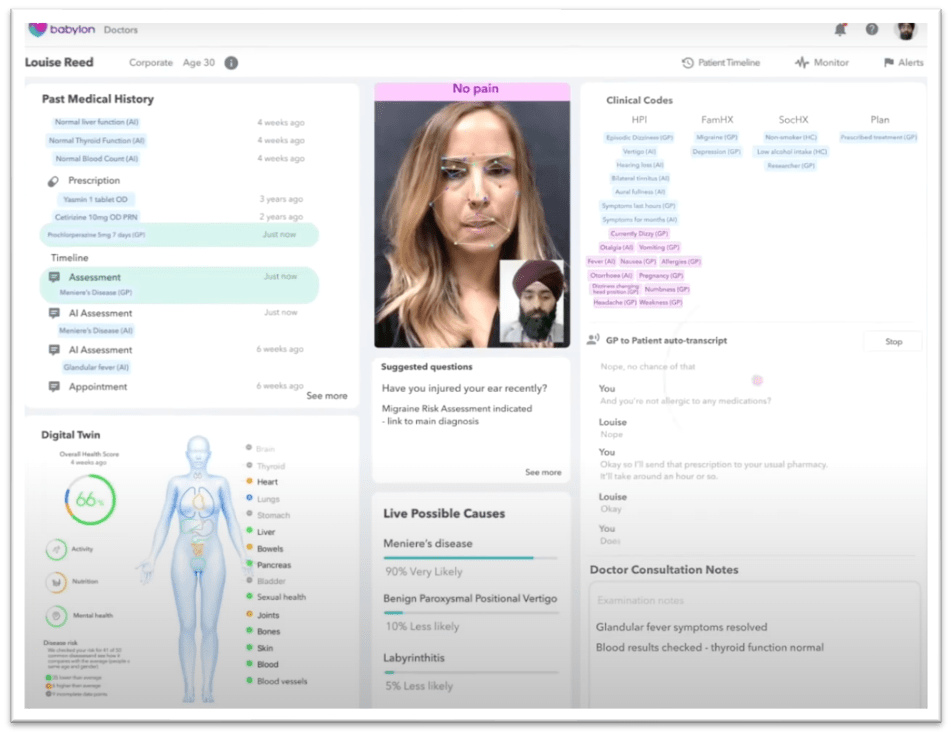
Note. This figure was taken from Benanti (2019). The doctor is presented with an aggregate of the patient’s previous health information and a live analysis with suggestions.
Exploiting, Implementing and Utilising AI in the Adjacent Business
There are several adjacent sectors such as healthcare real estate, biotechnology, and self-care. While it is safe to say that no sector will remain untouched by AI, it is especially the latter self-care sector, that is positioned for thorough disruption. Babylon Health also offers an AI-only service, where the patient communicates with the AI. Here the AI itself asks diagnostic questions and processes the patient’s answers until a highly likely cause for the patient’s discomfort is identified. The AI then has the power to place antibiotic orders to pharmacies and can be connected to Amazon Alexa, providing a payment gateway. Especially in the context of staff shortages and pay disputes in the provider sector, one can see how much value healthcare providers could capitalise on by investing in the self-care industry.
While the previous section outlined how much consultations can be improved in speed and cost through AI, here, the AI completely replaces the consultant meaning access to a consultancy session is only limited by processing power of the system, of which there is an abundancy at cheap prices compared to the hourly rate of human doctors. One might also consider Moore’s Law to foresee even greater future cost reductions. AI is not restricted physically, meaning it can consult everyone all at once (subject to server availability), solving a part of the issues with access. Especially previous innovation concerning access through telemedicine can now be expanded upon.
In summary, there is much more demand for healthcare provision than there is supply, and through AI, providers have the unique possibility to increase supply greatly and quickly. Because of an increase in the supply of healthcare provision, the directly related sectors of pharmacy services and manufacturers would also profit from increased demand for their products and services. Human consultants will likely treat much less standard cases and focus on the more complex cases, as AI will be able to deal with a large sum of standard cases.
Future Growth Opportunities
Future growth opportunities are almost indefinite as companies use AI to produce new applications by the day. One area in which AI will certainly have a significant impact is drug research & development (R&D), where it will lead to paramount cost savings and much faster development times. A good way to showcase the magnitude of AI-aided R&D is DeepMind’s 2022 publishment of their AI research, where they released the predicted structures of 200M+ catalogued proteins, expanding the previous database by over 200x.
Number of Modelled Protein Structures Known to Science
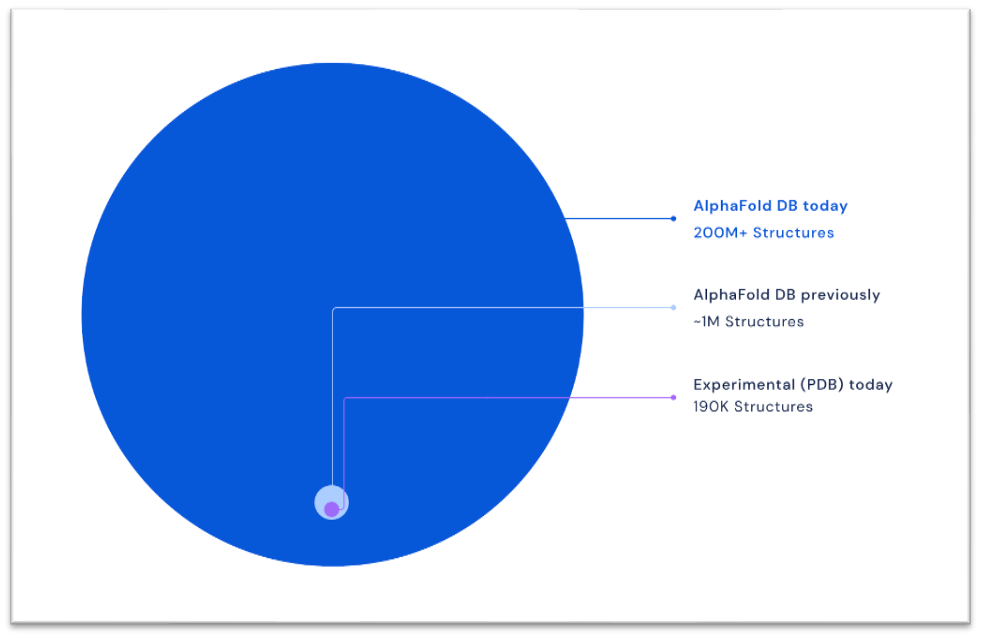
Note. This figure was taken from Google DeepMind (2022). The violet small circle in the middle is an expression of the protein structures modelled before AI was applied. Post AI, the blue circle expresses the number of modelled proteins, which are almost all that are known to science. This means medicine can be engineered much quicker and clinical trials can be largely modelled on computer systems.
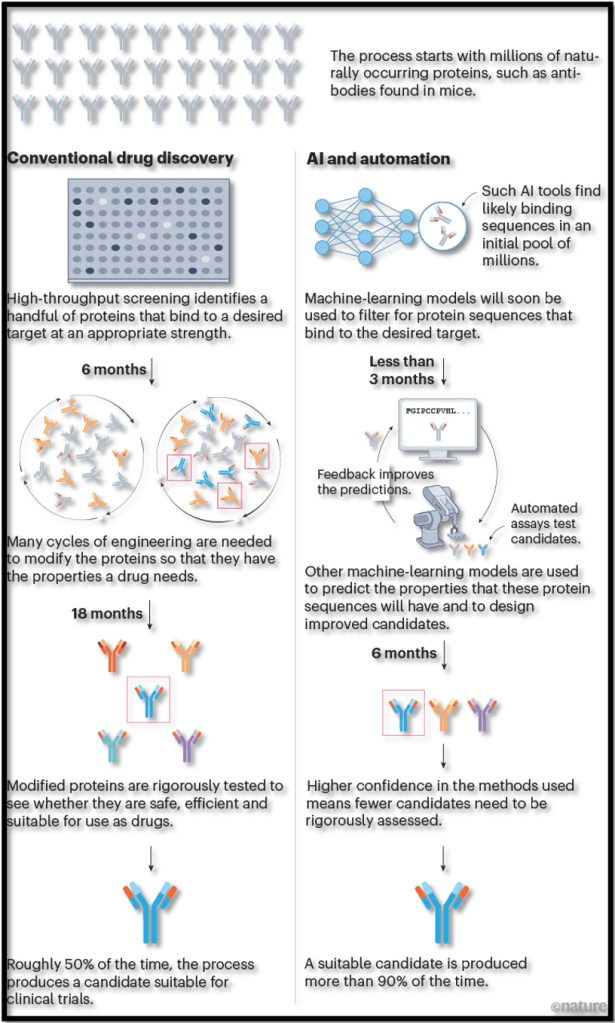
Drugs can then be developed based on the modelled proteins and digital trials can be simulated. In their article for Nature, Mock et al. (2023) provide a comprehensible graphic to illustrate how impactful AI truly is in the R&D process. In aggregate, AI is postured to impact the future growth of the entire healthcare industry by heavily impacting the underlying R&D world, which supplies the innovations upon which businesses capitalise and patient outcomes depend.
Challenges to the Adoption of AI in Healthcare
As is the case with all new inventions, artificial intelligence faces the natural challenge to business adoption, which is, passing through the technology adoption curve.
The Technology Adoption Curve
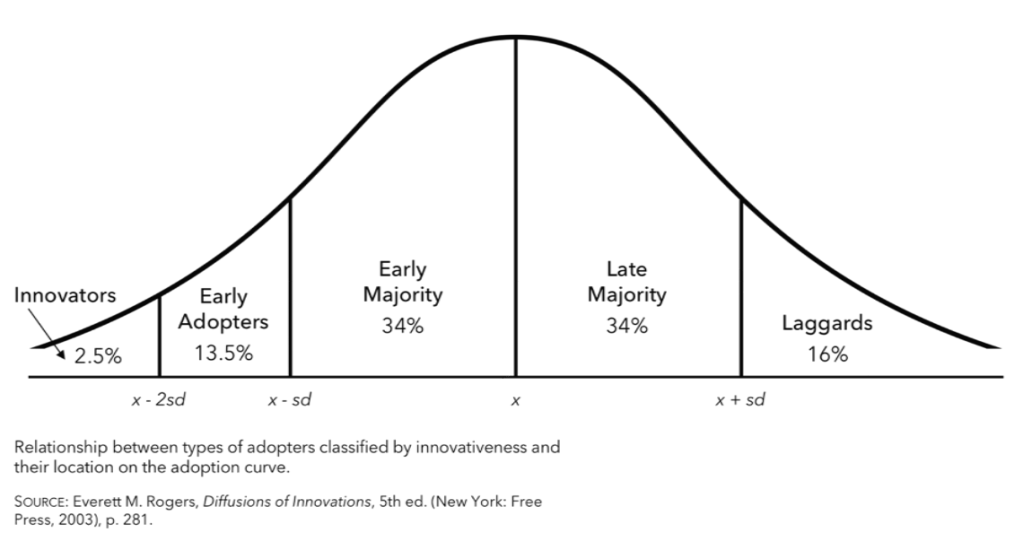
Roughly 34% of businesses will classify as “late” in terms of adopting AI, with 16% who will classify as laggards. Given the great impact of adopting AI into a company (as seen in the previous section), it is likely that those who do adopt will quickly outperform those who don’t which should speed up adoption. The healthcare industry will likely see that the ‘winners’ are those who leverage AI as a competitive advantage over their competition. The same is true globally where developed economies, who already have a significant advantage over others, will be at even more of an advantage through AI. AI can be expensive to run – R&D costs and costs associated with the number of calculations. One can see how such a reality can lead to a widening gap in development, where rich nations experience much more of an acceleration. It should be mentioned that because of its nature, the healthcare industry is largely part of the early adopters and innovators when comparing them against other industries. Thus, it is likely that AI adoption in healthcare will move faster than in other industries, however, late adopters and laggards within the industry itself will be a barrier, education about AI, how to use it and interact with it et cetera will be required.
Another significant challenge to business adoption is the safeguarding of AI and ethical processes and regulations. Few inventions have been the subject of as many dystopian visions as AI. However, one can see how ethical considerations aren’t prioritised, given the context of a global economy where the two largest healthcare markets, China and the US, are the world’s two greatest competing economies, that are set on getting the upper hand on the other in terms of technological superiority. A group of global industry leaders, most notably OpenAI investor Elon Musk, have recently signed a petition to halt AI development to allow for ethical safeguarding to be put in place, however said petition has not led to the asked-for goal, and development only sped up (Knight, 2023). Additionally, healthcare has always been an industry in which the success of risky innovation comes with the potential of great positive outcomes, more often than not, of life and death. Thus, even when regulators eventually finalise some sort of restrictive guidelines, the door for unrestricted innovation of AI in healthcare is very likely to always remain open, be it just in the R&D departments of corporate and academic institutions.
However, beyond develogpment, the application of the developed tools carries its own set of ethical challenges. One such challenge is the accountability of mistakes, and issues related to decision-making will surface. The most likely short-term scenario is that doctors will use AI to aid their decision making more and more but ultimately make the decision themselves and thus, carry the accountability. Furthermore, AI algorithms are “virtually impossible to interpret or explain” which will lead to problems such as when “a patient is informed that an image has led to a diagnosis of cancer, he or she will likely want to know why” according to Davenport & Kalakota writing for the Future Healthcare Journal (2019). These concerns are short-term challenges, likely to subside in the future as AI improves and normalises. Whatever the catalyst will be that allows for full trust in AI, once the trust is there, adoption and impact will be great. A catalyst could be anything that will allow people to put more trust into AI. For instance, one or many long-term studies that undoubtably prove that AI makes less faulty decisions than its human equivalents. At that moment the value of all the R&D, which will have progressed in the background, will become available at once.
Concluding Remarks
The healthcare sector has entered a new age that will come with rapid developments of great magnitude in almost all its core and adjacent sectors. However, this is nothing new for the industry, healthcare has been the subject of technological disruption and vast, paradigm-shifting innovations since its genesis. Because of that history of innovation and disruption, the industry is always ready to test, adapt & innovate, thus making healthcare one of the most fertile and exciting grounds for rapid AI application and development. While ethical concerns and safeguarding remain unclear barriers to innovation, certainly, they won’t stop the progress of the development of the AI tools themselves, however, the application of those might be much slower. Either way, as this research assignment has shown, the healthcare industry will exploit AI’s unique data processing capabilities to improve the provision of services, making them more accessible, accurate and affordable. Additionally, AI will have a major impact on the R&D that supports the entire industry, leading to faster new products, at cheaper prices. Finally, AI will establish sectors that are now adjacent such as the self-care sector and make them part of the core industry. As outlined in the introduction, this is not an exhaustive list, and one thing is sure, the future will hold many great consequences of AI in healthcare.
Sources
Benanti, P. (2019, May 13). Babylon NHS AI Portal Demo. http://Www.youtube.com. https://www.youtube.com/watch?v=mbiAp7P8thI
Davenport, T., & Kalakota, R. (2019). The potential for artificial intelligence in healthcare. Future Healthcare Journal, 6(2), 94–98. ncbi. https://doi.org/10.7861/futurehosp.6-2-94
Field, M. J. (1996). Introduction and Background. In http://www.ncbi.nlm.nih.gov. National Academies Press (US). https://www.ncbi.nlm.nih.gov/books/NBK45440/
Ghaffar Nia, N., Kaplanoglu, E., & Nasab, A. (2023). Evaluation of artificial intelligence techniques in disease diagnosis and prediction. Discover Artificial Intelligence, 3(1). https://doi.org/10.1007/s44163-023-00049-5
Google DeepMind. (2022, July 28). AlphaFold reveals the structure of the protein universe. http://Www.deepmind.com. https://www.deepmind.com/blog/alphafold-reveals-the-structure-of-the-protein-universe
Hixon, E., Buckenmeyer, J., Barczyk, C., Feldman, L., & Zamojski, H. (2012). Beyond the early adopters of online instruction: Motivating the reluctant majority. The Internet and Higher Education, 15(2), 102–107. https://doi.org/10.1016/j.iheduc.2011.11.005
Knight, W. (2023, September 28). Six Months Ago Elon Musk Called for a Pause on AI. Instead Development Sped Up. Wired. https://www.wired.com/story/fast-forward-elon-musk-letter-pause-ai-development/
Magunia, P., Schmid, C., & Grotelueschen, J. (2022, September 8). The pandemic and staff shortages have Germany’s hospitals fighting for survival. Roland Berger. https://www.rolandberger.com/en/Insights/Publications/Pub-Detail_101186.html
Mock, M., Edavettal, S., Langmead, C., & Russell, A. (2023). AI can help to speed up drug discovery — but only if we give it the right data. Nature, 621(7979), 467–470. https://doi.org/10.1038/d41586-023-02896-9
National Health Service (NHS). (2023). Telemedicine. http://Www.datadictionary.nhs.uk. https://www.datadictionary.nhs.uk/nhs_business_definitions/telemedicine.html
Owens, C. (2022, July 21). Health industry profits projected to rise by $31 billion between 2021 and 2025. Axios. https://www.axios.com/2022/07/21/health-industry-pandemic-profits
Patel, N., & Singhal, S. (2023, January 9). US healthcare developments in 2023 and beyond | McKinsey. http://Www.mckinsey.com. https://www.mckinsey.com/industries/healthcare/our-insights/what-to-expect-in-us-healthcare-in-2023-and-beyond
Romulus. (2018, May 18). The most powerful AI for healthcare – Babylon Health. http://Www.youtube.com. https://www.youtube.com/watch?v=Y8NkwQLo-6o
Spatharou, A., Hieronimus, S., & Jenkins, J. (2020, March 10). Transforming healthcare with AI: The impact on the workforce and organizations | McKinsey. http://Www.mckinsey.com. https://www.mckinsey.com/industries/healthcare/our-insights/transforming-healthcare-with-ai
U.S. Food and Drug Administration (FDA). (2019, February 8). Precision Medicine. FDA. https://www.fda.gov/medical-devices/in-vitro-diagnostics/precision-medicine
Waitzman, E. (2022, December 9). Staff shortages in the NHS and social care sectors. UK Parliament, House of Lord Library; The House of Lords. https://lordslibrary.parliament.uk/staff-shortages-in-the-nhs-and-social-care-sectors/#:~:text=In%20its%20report%20from%20June,early%20part%20of%20the%202030s.
