
“Ask not what your country can do for you, ask what you can do for your country”, this sentence is a quote from John Fitzgerald Kennedy, the 35th President of the United States of America and the leader discussed in this article. John Fitzgerald Kennedy, often abbreviated JFK, served as president from January 1961 until his assassination in November 1963. He is one of the most approved US presidents of all time (The American Presidency Project, 2021). JFK was born into an Irish Catholic, affluent, politically connected Boston family in 1917. He graduated cum laude from Harvard with a Bachelor of Arts in government, focused on international affairs. He served in the Second World War, returning as a war hero to work as a journalist, until starting his political career as a Democrat in the House of Representatives in 1946. JFK moved to the Senate in 1952, ran for president in 1960 and took office in 1961, as a married father of two. (John F. Kennedy Presidential Library And Museum, 2023)
The United States in the early 60s
In 1961 the USA experienced a sense of lost safety, originating from the intensification of the Cold War, the Vietnam War, the daunting Space Age, and the imminent threat of nuclear war with the Soviet Union. Domestically, civil rights and segregation were the main points of discussion. 1962, tensions with the Soviets grew further, signified by the Cuban Missile Crisis, the Space Race continued, and the civil rights movement gained more momentum. In 1963, a full US embargo of Cuba was announced. Martin Luther King Jr. gave his famous speech, regarded as one of the pivotal moments in the civil rights movement, and JFK was assassinated.
JFK’s Leadership Style
Kennedy’s leadership style was unique and a part of that was certainly his people focus, atypical for the time, however, not an unusual choice for a young leader. After researching him, in my view, he is a strong transformational leader as well as someone showing several elements of a democratic leadership style.
Figure 1, Transformational Leadership Characterised
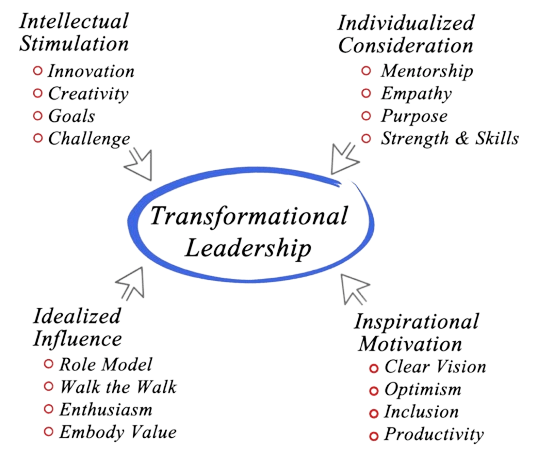
His ability to articulate a compelling vision, inspire people, and promote innovative thinking aligns well with the characteristics of transformational leadership. His vision for the space program and his call to public service are examples of transformational leadership in action. His democratic leadership side surfaced through his valuing of the input from his advisors and his seeking after a collaborative decision-making process. While he was decisive when needed, he recognized the importance of including others in the decision-making process, especially in matters of policy and strategy.
The Effectiveness of JFK’s Leadership
During the Second World War, the ship of which JFK was the captain was sunk by a Japanese destroyer. “After his ship was sunk and […] while the crew tred water, he explained the situation, sought their opinions, and then led them to the nearest island.” (Loftus, 2013). Transformational leadership seeks to identify the needs of others while democratic leadership facilitates a collaborative decision-making process.
Figure 2, Leadership Styles

Kennedy clearly demonstrated both these “People Emphasis” styles in the extreme situation he was in. This style of leadership leads to effective leadership in politics, or any position where one is to represent – and decide on behalf of – others. If presidents can empathise with – and consider -others over themselves, they will be more able to make decisions that benefit the wider population and thus be more effective at their job.
JFK’s Decision-Making
As president of the United States of America, one of the main functions of the job is to consider reports and make decisions based on those reports. One of Kennedy’s most infamous decisions has been named the Bay of Pigs Fiasco (Hart, 1991 & JFK Library, 2023), used by Yale psychologist Irving Janis to coin the term “groupthink” (Hansen, 2013). Groupthink refers to a psychological drive for consensus at the cost of discussing alternatives. Relating to the Bay of Pigs Fiasco, Hansen quotes historian Arthur Schlesinger, “who took part in that decision process, (and) later wrote that ‘our meetings were taking place in a curious atmosphere of assumed consensus, [and] not one spoke against it’.” (2013). This phenomenon of groupthink is one of the disadvantages of those leadership principles that rely on People Emphasis (compare Figure 2), such as the transformational and democratic styles Kennedy adopted.
On the upside, after the Bay of Pigs Fiasco, Kennedy showcased one of the most vital aspects of successful leadership and decision-making: reflection and adaption. He ordered a review of the Fiasco at a time when not even the US military had formal procedures in place to conduct reviews of missions, establishing a new standard for owning up to – and learning from – the mistakes one had made (Hansen, 2013). JFK then established four rules on how his team must operate from now on.
- Each participant should function as a “sceptical generalist,” focusing on the problem as a whole rather than approaching it from his or her department’s standpoint.
- To stimulate freewheeling discussions, the group should use informal settings, with no formal agenda and protocol, to avoid the status-laden meetings in the White House.
- The team should be broken into sub-groups that would work on alternatives and then reconvene.
- The team should sometimes meet without Kennedy present, to avoid people simply following his views.
(Hansen, 2013)
Kennedy identified that their democratic decision-making process was corrupted through external influences of the status-laden White House, the groupthink and the power of his own opinion. He applied these rules to counteract the negative influences the transformational and democratic model allowed for, thus championing and strengthening the styles’ upsides, mainly, the input and representation of a variety of experiences and views. This is a brilliant example of the importance of adapting each leadership style according to the circumstances.
Team Dynamics in the JFK Administration
According to the Roffey Park Institute (2021), Kurt Lewin, a German social psychologist, is credited with introducing the term “Group Dynamics” in the early 1940s, also known as Team Dynamics. Lewin described Team Dynamics through the interdependence of fate and task interdependence. Interdependence of fate is defined as the success of others affecting one’s own success, something which improves team dynamics. Task interdependence is defined as the co-dependence of one entity on others to absolve one’s tasks, something which, according to Lewin, improves team dynamics even more.
Kennedy’s transformational and democratic leadership style allowed for the processes Lewin described to function in full form. JFK set large goals for the entire administration, creating task interdependence. Additionally, by campaigning on these goals, the administration is interdependent in terms of fate, concerning re-election, and participation in other prospective political formations post their administrative term. Applying an autocratic style (compare Figure 2) would undermine the nature of task and fate interdependency since the dependency of both achieving goals and fulfilling fate would lie on the leader alone, offering little to strengthen team dynamics. One could argue that the Laissez Faire approach (compare Figure 2) might allow for interdependency of tasks and fate to naturally settle due to interlinked teamwork becoming even more of a need with no overarching leader. However, both fate & task interdependency require that overarching figure to set a vision, which determines fate, and to set and track objectives, ensuring interdependent tasks flow. Thus, it can be derived that Kennedy’s People Emphasis styles have been a vital part of allowing for a successful team dynamic.
JFK’s Administrative Success
One way to measure the organisational success of an administration is by measuring its popular approval. The goals of an administration are to improve the life of the people it is administering and to be re-elected. Both these goals can be expressed through measuring popular opinion[1]. As mentioned earlier, John F. Kennedy is one of the most approved of US presidents today. While Mr Kennedy’s untimely death has certainly improved his ratings and made him a martyr and a hero, he is still regarded as a successful president.
Figure 3, JFK’s Public Approval / Disapproval

Note. This graph was taken from The American Presidency Project, University of California (2023)
Comparing JFK’s approval graph to that of other US presidents[3], the decline in public approval during the administrative term is not unusual. It is in the nature of politics to make what one might call exaggerated promises. Once the administration tries to make them a reality, they often face an array of difficulties and do not meet said promises, which naturally leads to lower approval. That said, there are a few presidencies, such as Obama’s, Trump’s, Clinton’s and Reagan’s where approval ratings either remain stable or slightly improved over time. However, the total area under the approval graph is far larger for JFK than it is for either of the four, meaning throughout his presidency, he had a larger share of the population agreeing with him than the other four aforementioned presidents. In conclusion, we can say his presidency is among the most successful in the last 200 years.
An excerpt from the Council on Foreign Relations
“The second thing I would point to is how he compares to his successors: Lyndon Johnson, who had a credibility gap, and Richard Nixon, who was forced by the Watergate scandals to resign from the presidency. Neither of the two Bushes has anything resembling Kennedy’s hold on the public. Bush leaves office with a 29, 30 per cent approval rating. Jimmy Carter lost his re-election bid. Gerald Ford is disgraced by giving Richard Nixon a pardon in advance for the Watergate crimes. And Bill Clinton had the Monica Lewinsky affair. None of them can match up to Kennedy. When people want [to think about] hope in this country, they turn to Kennedy, and they turn to Ronald Reagan.“ (Dallek, 2011).
As mentioned throughout this article, JFK’s people-focused leadership style has had many positive impacts on organisational success. It is especially JFK’s ability to quickly adapt the style, according to the situation he and his team were in that led to success. Open communication, shared decision-making and responsibility, collective learning and the striving for a mutual vision are all part of the transformational and democratic leadership styles and were key tools used by the administration for organisational success. JFK’s highest spike in approval occurred when he successfully managed the Cuban Missile Crisis. The success of that crisis was a direct consequence of JFK’s improvements, made after he failed in the Bay of Pigs Fiasco. These improvements were an excellent example of championing the upsides of the transformational and democratic leadership styles, while adapting to the downsides, to lead to organisational success. Thus, it is the leadership styles in combination with smart situational adoption that led to success.
Ethical Considerations
Throughout his presidency, John F. Kennedy predominantly demonstrated ethical leadership. A good example of that is the tensions with Cuba. According to a report that was declassified in 1992, the US Department of Defence suggested launching a false flag operation that would have the CIA stage and commit acts of terrorism against American military and civilian targets, blaming them on the Cuban government (The Joint Chiefs of Staff, 1962). These acts of terrorism included terror in US cities, the possible assassination of Cuban immigrants, and the sinking of Cuban migrant ships amongst other acts (The Joint Chiefs of Staff, 1962). The desired result was to paint a bad image of Cuba on the world stage to justify the use of force, or war, against them, as Cuba began to become a bigger threat to American interests and safety. The Joint Chiefs of Staff[2] authenticated said plan, and Kennedy prevented it (Nelson, 2001). This shows excellent application of ethics, Kennedy overwrote the “groupthink” conclusion, likely, because of concerns with the ethics of the plan. Similarly, he acted ethically when opting to launch a blockade of Cuba instead of an invasion during the Cuban Missile Crisis.
The Civil Rights Movement was the major societal movement in JFK’s time. Kennedy’s support for civil rights was reflected in his endorsement of the March on Washington and the proposal of civil rights legislation. His ethical considerations in supporting racial equality were crucial in advancing the cause (John F. Kennedy Presidential Library and Museum, 2023).
Conclusion
John F. Kennedy was an outstanding man, president, and leader. This article showed how much overlap JFK’s leadership style and my native, German, culture had. Thus, it is unsurprising that I am inspired by his approach to leadership, as JFK brilliantly put it: “Ich bin ein Berliner”. Especially in times when the leadership of the US is void of inspiring stately figures, JFK’s presidential legacy shines bright. Like any human, Kennedy wasn’t perfect, he could have done more for the Civil Rights Movement, and had his missteps with the Bay of Pigs Fiasco, however, as outlined he learned from his mistakes and arose stronger from them. Additionally, one must not forget that JFK was extraordinarily young, the youngest US president at the point of his election. I believe if he had been given the chance to finish his first term and be re-elected, his impact and legacy would have been even greater. Beyond leadership in his job as president, I find JFK an inspiring figure because he embodies so many more archetypical signs of greatness that I can look up to. His role as a husband, a family father, a Christian, a war hero, an author, and a man of courtesy and statesmanship is something special and inspiring for me, especially in current times where these values seem to ebb off.
- Recollection Road. (2021, August 3). Flashback to 1963 – A Timeline of Life in America. http://Www.youtube.com. https://www.youtube.com/watch?v=YNxoouWyONA
- Dallek, R. (2011, January 21). Fifty Years On, What JFK Did, and Didn’t, Achieve (B. Gwertzman, Interviewer) [Interview]. In Council on Foreign Relations. https://www.cfr.org/interview/fifty-years-what-jfk-did-and-didnt-achieve
- Fulham, M. (2022, October 13). What we learned from the Cuban Missile Crisis. The Nuclear Threat Initiative. https://www.nti.org/atomic-pulse/ask-the-experts-the-60th-anniversary-of-the-cuban-missile-crisis/
- Hansen, M. T. (2013, November 22). How John F. Kennedy Changed Decision Making for Us All. Harvard Business Review. https://hbr.org/2013/11/how-john-f-kennedy-changed-decision-making
- Hart, P. (1991). Irving L. Janis’ Victims of Groupthink. Political Psychology, 12(2), 247–278. https://doi.org/10.2307/3791464
- JFK Library. (2023). The Bay of Pigs. Jfklibrary.org; John F. Kennedy Presidential Library and Museum. https://www.jfklibrary.org/learn/about-jfk/jfk-in-history/the-bay-of-pigs
- John F. Kennedy Presidential Library And Museum. (2023). Life of John F. Kennedy | JFK Library. http://Www.jfklibrary.org. https://www.jfklibrary.org/learn/about-jfk/life-of-john-f-kennedy#:~:text=Kennedy%2C%20a%20Democrat%2C%20served%20three
- John F. Kennedy Presidential Library and Museum. (2023). Civil Rights Movement | JFK Library. http://Www.jfklibrary.org. https://www.jfklibrary.org/learn/about-jfk/jfk-in-history/civil-rights-movement#:~:text=Kennedy%20defined%20the%20civil%20rights
- Loftus, G. (2013, November 20). JFK: Myth Or Great Leader? Forbes. https://www.forbes.com/sites/geoffloftus/2013/11/20/jfk-myth-or-great-leader/
- Miller Center. (2018, May 21). John F. Kennedy – Key Events | Miller Center. Miller Center. https://millercenter.org/president/john-f-kennedy/key-events
- Nelson, A. K. (2001). Operation Northwoods and the Covert War against Cuba, 1961–1963. Cuban Studies, 32(1), 145–154. https://www.jstor.org/stable/24486204?typeAccessWorkflow=login
- Recollection Road. (2021a). Flashback to 1961 – A Timeline of Life in America. In YouTube. https://www.youtube.com/watch?v=W1Y_ZfmZbFc
- Recollection Road. (2021b, July 27). Flashback to 1962 – A Timeline of Life in America. http://Www.youtube.com. https://www.youtube.com/watch?v=xbLA_NbHgSw
- Rubenzer, S. (2020). What Makes a Good President? Apa.org. https://www.apa.org/news/press/releases/2000/08/presidents
- Selverstone, M. J. (2018, April 10). John F. Kennedy: Impact and Legacy | Miller Center. Miller Center. https://millercenter.org/president/kennedy/impact-and-legacy
- Smyser, W. R., Kissinger, H. A., Stein, M. B., Livingston, R. G., & Schaefer, B. (2009, October 1). Kennedy and the Berlin Wall: A Hell of a Lot Better Than a War | Wilson Center. http://Www.wilsoncenter.org. https://www.wilsoncenter.org/event/kennedy-and-the-berlin-wall-hell-lot-better-war
- The American Presidency Project. (1943, December 15). Franklin D. Roosevelt Public Approval | The American Presidency Project. http://Www.presidency.ucsb.edu. https://www.presidency.ucsb.edu/statistics/data/franklin-d-roosevelt-public-approval
- The American Presidency Project. (1960, December 13). Dwight D. Eisenhower Public Approval | The American Presidency Project. http://Www.presidency.ucsb.edu. https://www.presidency.ucsb.edu/statistics/data/dwight-d-eisenhower-public-approval
- The American Presidency Project. (1969, January 6). Lyndon B. Johnson Public Approval | The American Presidency Project. http://Www.presidency.ucsb.edu. https://www.presidency.ucsb.edu/statistics/data/lyndon-b-johnson-public-approval
- The American Presidency Project. (1974, August 5). Richard M. Nixon Public Approval | The American Presidency Project. http://Www.presidency.ucsb.edu. https://www.presidency.ucsb.edu/statistics/data/richard-m-nixon-public-approval
- The American Presidency Project. (1976, December 13). Gerald R. Ford Public Approval | The American Presidency Project. http://Www.presidency.ucsb.edu. https://www.presidency.ucsb.edu/statistics/data/gerald-r-ford-public-approval
- The American Presidency Project. (1988, December 29). Ronald Reagan Public Approval | The American Presidency Project. http://Www.presidency.ucsb.edu. https://www.presidency.ucsb.edu/statistics/data/ronald-reagan-public-approval
- The American Presidency Project. (1993, January 11). George Bush Public Approval | The American Presidency Project. http://Www.presidency.ucsb.edu. https://www.presidency.ucsb.edu/statistics/data/george-bush-public-approval
- The American Presidency Project. (2001, January 14). William J. Clinton Public Approval | The American Presidency Project. http://Www.presidency.ucsb.edu. https://www.presidency.ucsb.edu/statistics/data/william-j-clinton-public-approval
- The American Presidency Project. (2017, January 19). Barack Obama Public Approval | The American Presidency Project. http://Www.presidency.ucsb.edu. https://www.presidency.ucsb.edu/statistics/data/barack-obama-public-approval
- The American Presidency Project. (2021, April 24). Presidential Job Approval Ratings Following the First 100 Days | The American Presidency Project. http://Www.presidency.ucsb.edu. https://www.presidency.ucsb.edu/statistics/data/presidential-job-approval-ratings
- The American Presidency Project. (2023). John F. Kennedy Public Approval | The American Presidency Project. http://Www.presidency.ucsb.edu. https://www.presidency.ucsb.edu/statistics/data/john-f-kennedy-public-approval
- The Joint Chiefs of Staff. (1962). Justification for US Military Intervention in Cuba. In National Security Archive (pp. 1–15). https://nsarchive2.gwu.edu/news/20010430/northwoods.pdf
- The Joint Chiefs of Staff. (2023). About the Joint Chiefs of Staff. http://Www.jcs.mil. https://www.jcs.mil/About/#:~:text=
The%20Joint%20Chiefs%20 of%20Staff%20consist%20of%20the%20Chairman%2C%20the
[1] Another, more empirical, way to measure organisational success is through the performance of the administration with the problems it faced as well as according to an array of metrics including employment, GDP, crime, debt etc. For the sake of keeping this article within the word count, public opinion was chosen to express a conclusion of overall performance. Assuming that people’s judgement is made out of considering a synthesis of all relevant metrics.
[2] “The Joint Chiefs of Staff consist of the Chairman, the Vice Chairman, the Chief of Staff of the Army, the Chief of Naval Operations, the Chief of Staff of the Air Force, the Commandant of the Marine Corps, the Chief of the National Guard Bureau and the Chief of Space Operations.” (The Joint Chiefs of Staff, 2023).
[3] Obama (The American Presidency Project, 2017), Clinton (The American Presidency Project, 2001), Bush (The American Presidency Project, 1993), Reagan (The American Presidency Project, 1988), Ford (The American Presidency Project, 1976), Nixon (The American Presidency Project, 1974), Johnson (The American Presidency Project, 1969), Eisenhower (The American Presidency Project, 1960), Roosevelt (The American Presidency Project, 1943).
